
For centuries, Libya’s geography was its advantage. Now, its free zones are giving that advantage a commercial framework.
As global trade becomes more uncertain, companies are looking beyond traditional routes and established hubs. They are thinking more carefully about resilience, regional access, port capacity, warehousing, distribution, and how to reduce dependence on single corridors or overstretched logistics networks.
For companies looking across the Mediterranean, North Africa, and wider African markets, Libya is becoming part of that conversation again.
The reason is not just location. Libya has always had that. What is changing is the infrastructure, investment activity, and commercial structure being developed around the strategic location.
A key part of this story is the development of Libya’s free zones, especially Misurata Free Zone in the west and Julyana Free Zone in Benghazi in the east.
Why Free Zones Matter
Free zones are designed to make trade and investment easier.
For international companies, they can provide a more flexible environment to establish a presence, move goods, manage storage, support regional distribution, or build commercial operations with fewer barriers than the wider domestic market.
In Libya, that framework is especially important. Libya’s free zone laws provide several incentives for investors, including 100% foreign business ownership, no customs duties or hidden charges on imports into and exports out of the free zone, 0% personal or corporate income tax, no restrictions on repatriation of capital and profits, and simplified company formation.
That matters because, for many international companies, the first question is whether Libya has a simplified structure that allows them to enter, operate, and scale. These special economic zones are designed to create a more favorable business environment, reduce market entry obstacles and offer greater legal protection.
Free zones can support transit trade, warehousing, distribution, light assembly, re-export activity, after-sales service, regional servicing, and logistics support. They also give companies a base from which to serve the Libyan market while assessing broader access into North Africa and inland African markets.
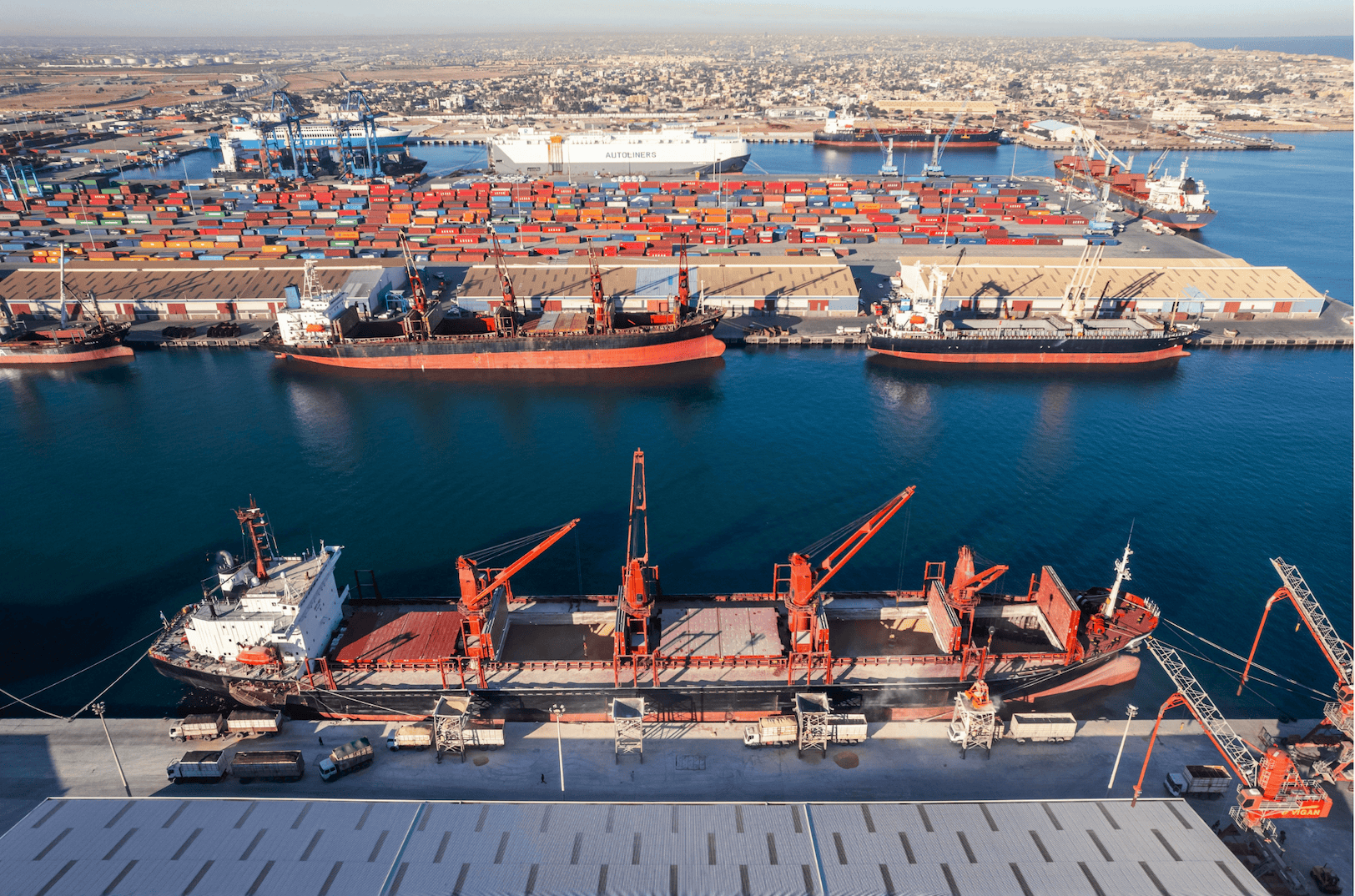
Misurata Free Zone: Libya’s Western Trade Platform
Misurata Free Zone (MFZ) is Libya’s largest free zone, established in 2000, and is positioned on the Mediterranean coast in one of the country’s most commercially active cities. The zone is positioned and investing to become a central hub for Europe-Africa trade. It is home to Libya’s busiest commercial seaport, responsible for approximately 60% of the country’s non-oil trade volume.
The MFZ is already a functioning logistics platform with port infrastructure, a number of active industries, and investor support services experienced in handling international companies.
Toyota Libya is one clear example. Toyota Libya F.Z.C. was established inside Misurata Free Zone as the exclusive distributor of Toyota vehicles and spare parts in Libya, and is a 100% subsidiary of Japan’s Sumitomo Corporation. Toyota Libya also lists several facilities inside the free zone, including training centres, a pre-delivery inspection centre, a spare parts warehouse, and a vehicle stock yard.
Misurata has also attracted Huawei to set up a base of operations and support the MFZ’s goals to advance its digital infrastructure across communications, surveillance, facilities management, and service delivery.
The free zone conversation is moving beyond basic warehousing and into technology, smart infrastructure, port efficiency, and regional logistics.
The Misurata Port Expansion
The biggest recent development is the major investment partnership to expand and develop Misurata Free Zone Port.
This year, Libya signed a $2.7 billion strategic partnership with international firms to expand and develop the Misurata Free Zone, involving Terminal Investment Limited, the port operator of MSC Group, and Doha-based Maha Capital Partners. The project is expected to help Misurata Free Zone Port become one of the largest logistic hubs between Africa, Europe, and the Middle East.
The partnership is significant because it moves the free zone story from incentive-led investment promotion to hard infrastructure.
The MFZ announced the project as a public-private partnership (PPP) to modernise, manage, develop, and expand the port, with plans to increase container-handling capacity, accommodate larger vessels, deploy new terminal equipment and digital systems, and enhance safety, performance, and environmental standards.
This is the kind of development that changes how companies view a market. Ports, handling capacity, storage, customs processes, digital systems, security, and transport links determine whether companies can actually use that market as part of a wider logistics network.
For Misurata, the ambition is clear: to move from a nationally important commercial port into a Mediterranean logistics platform.
Julyana Free Zone: Benghazi’s Eastern Gateway
In the east, Benghazi’s Julyana Free Zone (JFZ) is developing its own role in Libya’s trade and logistics landscape.
Julyana positions itself as a gateway to global markets, with more than 120 hectares of total area under development. Its official platform highlights logistics services including transport and distribution, customs clearance, marine services, storage and warehousing, handling, and shipping. It also lists investor advantages including 100% foreign ownership, tax incentives, customs exemptions, fast licensing procedures, proximity to European and African markets, and a developed logistics environment.
The JFZ is becoming increasingly important to Benghazi’s commercial recovery and eastern Libya’s trade infrastructure. Its year-over-year growth is notable, jumping from 240,181 containers in 2024 to 325,916 in 2025. Development and modernisation projects are still underway including quay expansion, grain silos, new state-of-the-art machinery, and improved storage facilities.
Julyana Free Zone’s investment in capacity and handling is already translating into stronger connectivity. In May 2026, COSCO launched a direct shipping line between China and Benghazi, creating a route expected to reduce import costs for Chinese and Korean goods while strengthening JFZ’s role as a transit hub for cargo moving into Mediterranean and African markets.
Taken together, these developments point to a clear direction: Julyana is building the infrastructure and service environment to support more trade. With the scope of commercial activity taking place in Benghazi and eastern Libya, JFZ is becoming a more relevant base for companies looking to serve the east and beyond.
What This Means for International Companies
For international companies, Libya’s free zones offer three important possibilities.
The first is market entry. Free zones can provide an easier and more flexible route for establishing a presence, testing demand, building partnerships, and managing early-stage activity.
The second is logistics positioning. Misurata and Benghazi both sit on the Mediterranean, with potential relevance to North African, European, and wider African trade flows.
The third is operational optionality. Companies can use free zones to support warehousing, distribution, imports, re-export, transit trade, servicing, or light industrial activity while managing risk and exposure in a more structured way.
This should not be misunderstood. Libya’s free zones reduce friction but do not remove all complexity.
Companies still need to understand customs processes, banking constraints, regulatory requirements, movement planning, local suppliers, workforce arrangements, security conditions, and the practical realities of operating on the ground.
Even inside a free zone, execution matters.
The Risk Question Still Matters
The opportunity is real, but so is the need for preparation.
Misurata and Benghazi are commercially active cities with growing infrastructure, visible investment, and stronger business momentum than many outside observers may assume. But Libya remains a market where companies need to plan carefully.
The UK Foreign, Commonwealth & Development Office currently advises against all but essential travel to the cities of Tripoli, Benghazi and Misrata, while continuing to advise against travel to other areas of Libya depending on location.
For companies, that does not mean the market is closed but it does mean entry needs to be structured properly.
The difference between opportunity and execution is often found in the details: who receives the team, who manages the movement, who coordinates with local stakeholders, who understands the documentation, who tracks the operating environment, and who can respond when requirements change. Here Libya rewards preparation and understanding the local dynamics on the ground.
What Companies Should Consider Before Entering
Before looking at Libya’s free zones, companies should ask practical questions.
Which zone best fits the commercial objective: western Libya, eastern Libya, the domestic market, Mediterranean access, African distribution, or a specific sector?
What is the intended operating model: warehousing, import and distribution, assembly, servicing, re-export, or market representation?
What documentation is required before entry?
What banking, payment, tax, and customs issues need to be understood early?
What movement and security arrangements are required for visiting teams?
Which local stakeholders, authorities, suppliers, and service providers need to be engaged?
And most importantly: what support structure needs to be in place before activity begins?
These questions matter because Libya is not a market where companies should arrive first and solve the operating model later.
The companies that will benefit most are the ones that prepare properly, assess the risks realistically, and build the right local support around their commercial plans.
A Familiar Role, in a New Form
Libya’s role as a trade connector is not new. Libya has always had the geography to connect Europe, North Africa, and wider African markets. The question today is whether that geography can be turned into reliable commercial value.
Misurata and Benghazi are both moving in that direction. Misurata is building around port expansion, international partnerships, and its role as a national trade gateway. Julyana is building around rising maritime traffic, modernised handling capacity, direct shipping links, and eastern Libya’s commercial momentum.
For international companies reassessing how they access North Africa, the Mediterranean, and wider African markets, Libya’s free zones deserve a closer look.
But opportunity alone is not enough. Entering Libya requires preparation, local insight, and the right operational structure around logistics, mobility, security, and risk management.
At Expertise Consultancy, we continue to track the developments shaping Libya’s trade and infrastructure environment, helping companies understand the market, prepare properly, and operate with confidence on the ground.
To discuss market entry or operational support in Libya, contact EC here or email info@ec.ly.
On the ground. In the know.